
'The Drama' is quite dull actually
Once a filmmaker gets to a certain level, perhaps the industry forces him to not only identify with but embrace mediocre white men. Otherwise, it’s hard to explain why Kristoffer Borgli so successfully interrogated and blew up the same type in Dream Scenario, but invests so heavily in such a dull, uninteresting stock character in his follow-up The Drama. At Zendaya’s expense no less.
Zendaya is an insanely charismatic performer, one of only a small handful of talent from her generation to emerge as a movie star in an age when privacy is becoming a mere flourish rather than a right given away freely and gladly on social media. Placing her alongside an actor like Robert Pattinson, whose range perfectly matches his now carefully curated ambition, should be a guaranteed good time.
Yet The Drama bungles the job to such a degree that even the movie’s marketing fails to live up to its basic premise, which hinges on a twist that is dependent upon an unwillingness to spoil it. I won’t here, but safe to say it isn’t a twist at all - it’s a reveal of a very dark secret of Zendaya’s Emma, who is all set to marry Pattinson’s Charlie. Until, that is, she reveals a very dark teenage dream she once had mere days before the wedding.
Suddenly, Charlie is questioning just how well he actually knows the woman he’s adorably attached to, makes passionate love to, and is set to share a life with. And Emma? Well, she’s…along for the ride, and mostly flailing in her attempts to have the same sense of connection she once had with him.
As we get to know the young Emma (Jordyn Curet) and her teenage fascination with violence, the movie declines to take a similar dive into her adult life, saving its energy for how she decided to take a starkly different path than the one she intended. In other words, Emma contemplated and even flirted with a very heinous deed, but it was an act that ended up not only unfulfilled, but without any kind of harm or consequences to anyone but herself.
It makes the film’s central premise ring rather hollow, hardly helped by the fact that this is an issue which is explored without any kind of racial or political context. Putting a Black actress in the middle of a situation where she is a willing participant in and catalyst for an act of violence, even for one as beautifully modelesque as Zendaya, is going to have ramifications, but The Drama is incapable of acknowledging race or gender as genuine forces that can shape a life.
Movies like these tend not to do too well in these areas. Settings like these, with airy, light-filled spaces that include upper class trappings of immaculately stacked bookshelves, with firmly upper class professions to match, Harper’s Magazine T-shirts, and cosmopolitan, outwardly diverse friend groups, typically tend to collapse when a sense of reality crashes in. Especially when it’s outside the boundaries of what is deemed an acceptable experience.
Charlie of course is going to be the safest perspective to explore the movie’s stated themes, and he is so banal about it that the only question is why Emma would still choose to be with him. If the movie had invested in her beyond a few throwaway lines, it could’ve been interesting, but instead it’s the usual straight while male anxiety about commitment and relationships.
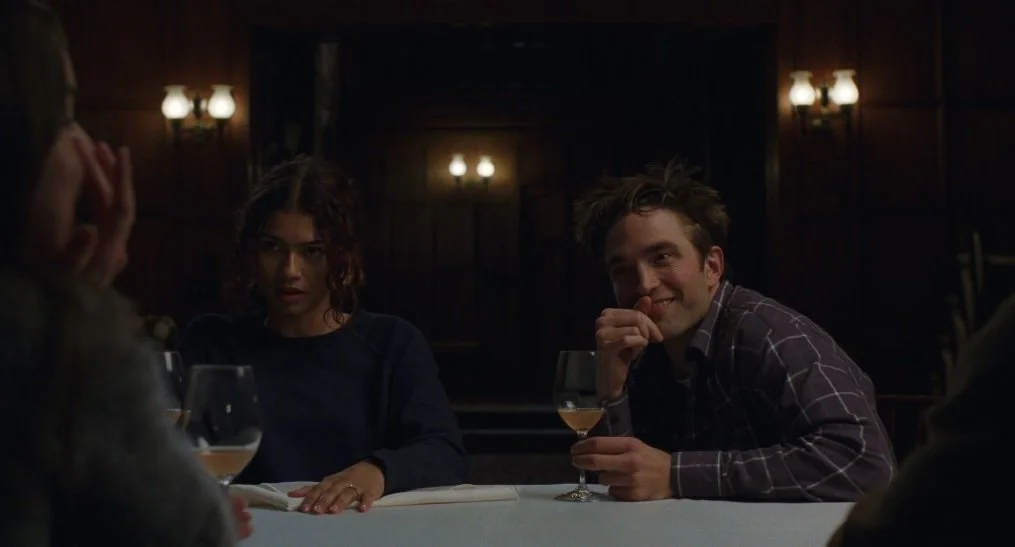
A24
It’s been pointed out that this is part of an ongoing trend of prestige movies by white directors making Black women the center of the action, only to shift away by centering their bumbling white male partners. But there’s also something more sinister as this movie devolves from its romcom opening to its more serious ambitions - it’s also a way to make women the originators of destructive acts mostly perpetrated by men. Tár is one of the most lauded examples, saving its criticisms not for those who actually commit violence and those that enable them, but for those who try to hold them accountable, aka so-called cancel culture.
It’s also a way to be provocative without truly provoking by engaging in how predatory behavior is enabled and expected by some. A film like The Assistant is capable of centering the experiences of a vulnerable woman who slowly awakens to what her boss is engaging in and what she realizes she is complicit in, but films like The Drama are incapable truly of seeing themselves in anyone except the white male directors who make them. The movie at least has a dark sense of humor that carries it at points, and I suppose that’s remarkable for a film so invested in mediocrity.
Rating: C-